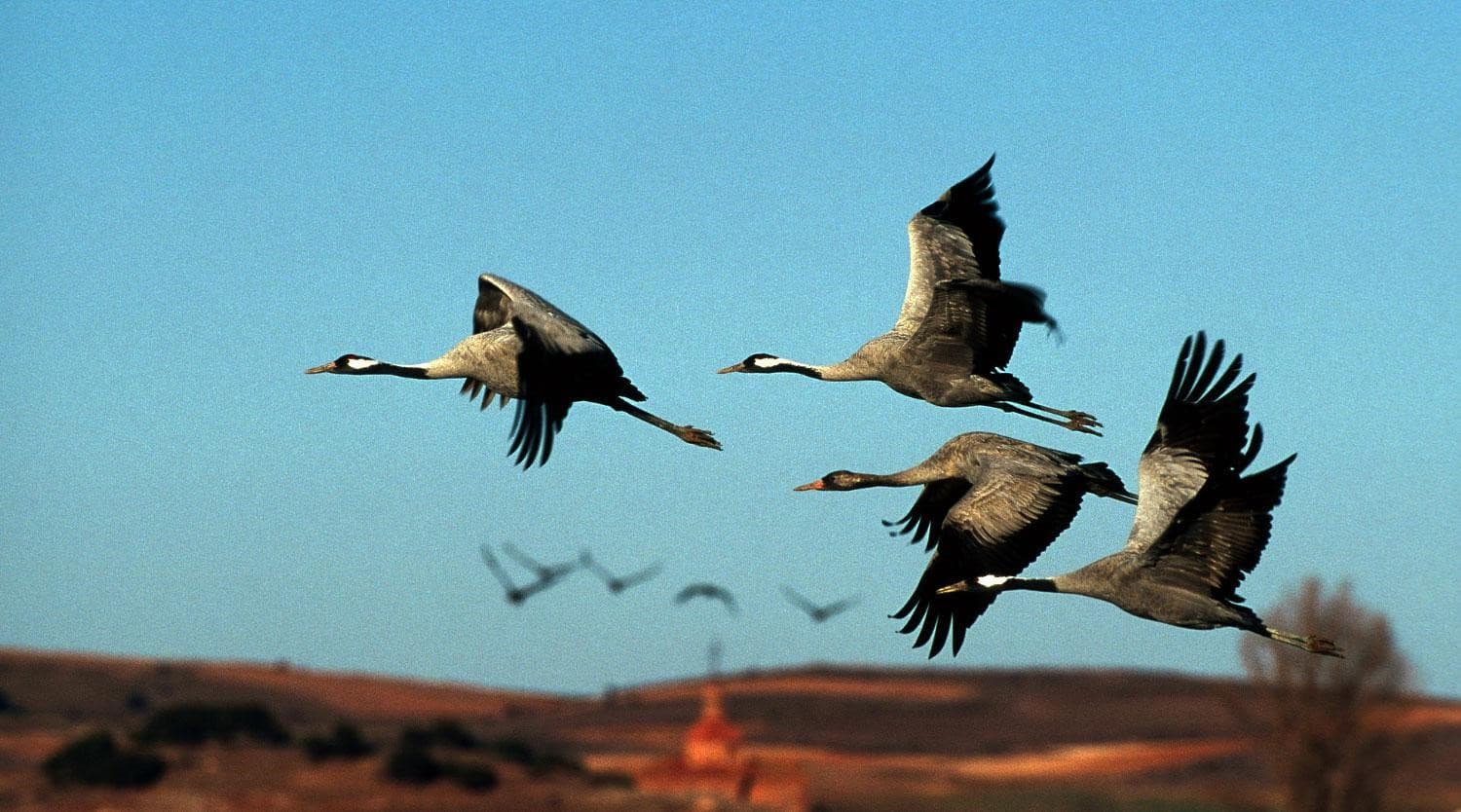
Every year, millions of birds travel thousands of kilometers, returning to the same places with astonishing precision. Young birds make their first migration unaccompanied by adults, while adults find last year’s nests after months of travel. Birds, however, have no maps, instruments, or “built-in navigators” in the traditional sense. Their orientation results from a complex set of biological mechanisms, some of which have been experimentally confirmed.
How do birds navigate?
It’s important to understand: there is no single, universal “avian GPS.” Navigation is a system of redundant landmarks that complement one another and are activated under specific conditions.
Earth’s Magnetic Field
The most studied mechanism is magnetoreception. Experiments have shown that many bird species detect the Earth’s magnetic field and use it as a compass. This involves perceiving the tilt of magnetic lines and their intensity.
Studies using altered magnetic fields in laboratory conditions have shown that when the field is “rotated,” birds change their orientation. This confirms that the magnetic field is used actively rather than randomly. It is believed that specialized proteins in the retina (cryptochromes), sensitive to the magnetic effects of light, are involved. Thus, orientation may be partially “visual” and not just tactile.

Starry Sky and the Sun
Many birds navigate using celestial objects. Classic planetarium experiments have shown that nocturnal migrants use the position of the stars relative to the celestial rotation axis. If the “star map” is altered, the birds change their flight direction.
During the day, the Sun plays a similar role. However, not only is its position important here, but also the bird’s internal biological clock. Birds take into account the Sun’s movement across the sky and adjust their direction depending on the time of day. When circadian rhythms are artificially shifted, solar orientation is disrupted, as confirmed in controlled experiments. This mechanism is especially important in clear weather, when celestial cues are readily available.
Olfaction
It was long believed that birds barely use their sense of smell. This view has now been revised. Experiments with seabirds and pigeons have shown that odors play an important role in navigation, especially during the final stages of a route. Birds can memorize “olfactory maps”—combinations of odors characteristic of regions.
When olfactory blockade is introduced, experienced birds experience a sharp decline in their ability to return to their nesting site, even if other landmarks are preserved. This is especially noticeable in conditions of poor visibility, when visual cues are unavailable.
Landscape and Visual Memory
Experienced migrants use terrestrial landmarks, such as coastlines, mountain ranges, large rivers, forested areas, and even urban structures. They form a visual map of their route, which is refined each year. Satellite tracking has shown that adult birds fly more direct and consistent routes than juveniles.
This suggests the accumulation of spatial memory. If the landscape changes dramatically—due to deforestation, development, or altered river channels—routes may shift, and migration success may decline.

How do these mechanisms work together?
None of the described methods is sufficient on its own. Birds combine signals, switching between them depending on conditions. This is what makes navigation robust. In simplified form, the system looks like this:
- the magnetic field sets the general direction;
- the stars and the Sun clarify the course during good visibility;
- scents help at the regional and local level;
- the landscape reinforces the route and improves return accuracy.
If one landmark is temporarily unavailable, the others compensate.
Why young birds don’t “know the way” but still arrive
An interesting fact: in many species, the first flight is based not on a precise route, but on an innate program of direction and distance. Young birds fly “south for such and such a time,” using a magnetic compass and celestial landmarks. Specific locations are established in subsequent years. This explains why first migrations are less precise and more risky, while adults exhibit a high degree of route repetition.
What’s disrupting navigation today
Modern research shows that anthropogenic factors can interfere with several orientation mechanisms simultaneously. Light pollution disrupts stellar navigation, electromagnetic noise can affect magnetic perception, and landscape degradation destroys visual cues. Therefore, understanding how birds navigate is important not only from a scientific perspective. It allows us to predict the consequences of infrastructure solutions and assess the risks to migratory species.
Bird migration is not an instinct in the simplified sense, but a complex system of sensory and cognitive mechanisms honed by evolution. And the more we learn about it, the clearer it becomes: even small environmental changes can have consequences over thousands of kilometers of travel.